
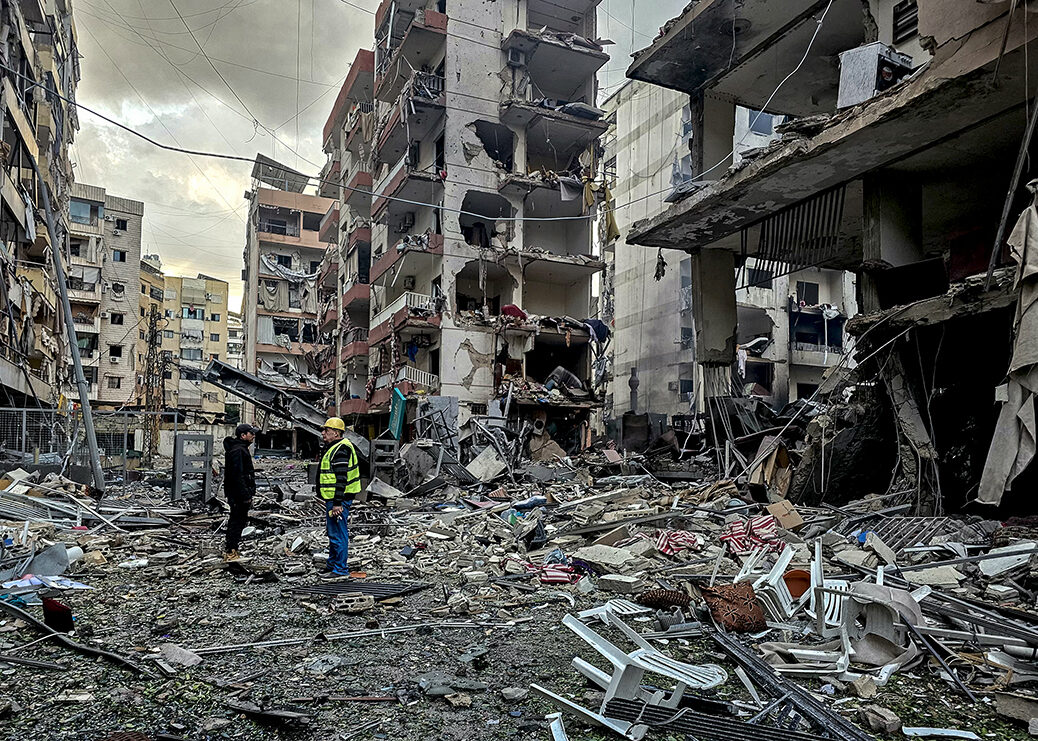
Damascus Airport is shut because of the Iran war, so you drive to the Syrian capital from Amman in Jordan. The first thing you notice when travelling to Damascus – other than the mural of an eagle at the border crossing with the words “Syria is free… take a selfie”, and the air-raid sirens from the Jordanian side marking the arrival of missiles heading from Iran to Israel – is that Syria is covered in solar panels. It seems every building, even those bombed out, is generating renewable electricity.
Two Syrian International Rescue Committee (IRC) staff accompanying my visit told me about the first time they returned after the fall of the hated Bashar al-Assad regime. Both described their tears on crossing the border. For one, the trigger was being told “welcome home” by a border guard. For the other it was the sight of a new Syrian flag.
Last year was one of liberation for Syria. This year threatens to drag the country down, as increased fuel prices and the stalling of Gulf investment as a result of the war eat away at still sky-high expectations of change.
I visited an IRC-supported hospital in Homs, in the west of the country, and a centre for women and girls. In both, I talked to clients who had returned from Lebanon: some who came back as soon as Assad fell, others more recently; still others fleeing a Palestinian refugee camp in Lebanon where they had rented space to live but now feared missile attacks.

They talked about being “alive again”, about feeling nothing for the foreign place where they spent 13 years. But they also talked about “coming back to zero” because their homes in Homs were no more, about feeling like strangers in their own land, about the lack of work. Land mines are still to be cleared; hospitals need to be rebuilt (60 per cent were destroyed or damaged in the civil war); housing is yet to be restored; and now there are wars to both the east and the west.
The government in Syria says it is determined to stay out of the fight. Lebanon does not have a choice. I was shown an app that allows Lebanese people to calculate how much of their life has been lost to war. For a 38-year-old, it is 57 per cent. Just 16 months after the last ceasefire in Lebanon, conflict is back with a vengeance.
Hezbollah rockets were sent into Israel on 2 March, to mark the killing of the Iranian supreme leader, Ali Khamenei. In the ensuing Israeli assault, 1,400 people are reported to have been killed, and more than a million forced to flee their homes. The scale of displacement is so large that it is hard to fathom. In proportionate terms, it’s like 17-20 million Brits being forced to seek shelter in another part of the country: as if almost twice the population of Scotland, Wales and Northern Ireland were forcibly moved to somewhere within England.
Only 15 per cent of those displaced are in government shelters, in schools and football stadiums. Most of the rest are sleeping on the floors of relatives and friends. Jobs as well as homes are lost, and government payments to the poorest ($145 a month, if funds are available) do not cover the costs of the basics.
I met the wife of a baker in a government shelter where IRC is delivering services. She said her husband’s business in the town of Bint Jbeil, near the border with Israel, had been bombed in the 2024 conflict, so they moved to Tyre on the coast. Now, they have been forced to move again. She says her seven-year-old child covers her ears at the slightest bang, because missile strikes have been so normalised.
In the midst of the displacement, there is extraordinary as well as ordinary life. I met a student of atomic physics trying to do his studies online. He’s not giving up.
Those displaced are predominantly from Shia communities. Many wonder if they will ever be allowed back home. And the quietly spoken question then is how Lebanon’s social compact will survive.
As the war grinds on, the humanitarian consequences fit into three categories. There are the direct effects of conflict in Iran and Lebanon. Then there are the indirect effects, via higher energy prices and blocked fertiliser supplies. Thirty per cent of the world’s fertiliser is supposed to come through the Strait of Hormuz; the Council on Foreign Relations calls the war a “slow-motion famine machine”. The 170 million people in the world already living at crisis levels of hunger can’t afford any interruption in food supplies.
And then there is the geopolitics. One example: the energy crisis and the boost in oil and gas prices has been a godsend for Russia, bolstering its ability to fight in Ukraine. That has humanitarian consequences, too.
The Iran war could not have come at a worse time for either Lebanon or Syria. They exemplify the ripple effects from a conflict no one had planned for (except maybe the Iranian regime). It’s a connected world, and unless the shock absorbers are put in place quickly, the ripples are going to be felt far and wide.
[Further reading: Why Trump keeps escalating in Iran]
Content from our partners
Related
This article appears in the 08 Apr 2026 issue of the New Statesman, The Fall
Join the debate
Subscribe here to comment